A common way to talk about 45Z is that a lower carbon-intensity score creates more tax-credit value. That is directionally right, but it is not mathematically smooth.
Section 45Z first converts the fuel's lifecycle emissions rate into an emissions factor. The statute then requires that factor to be rounded to the nearest 0.1. For 2026, IRS Notice 2026-41 sets the prevailing-wage-and-apprenticeship alternative amount for non-SAF transportation fuel at $1.09 per gallon. (IRS Notice 2026-41)
Put those two rules together and one step in the rounded emissions factor is worth:
$1.09 × 0.1 = $0.109 per gallon
or 10.9 cents per gallon.
That creates something closer to a staircase than a straight line. A fuel producer can lower its lifecycle emissions rate and receive no increase in the rounded 45Z factor. Then a very small additional improvement can cross the next rounding threshold and increase the gross credit amount by 10.9 cents per gallon.
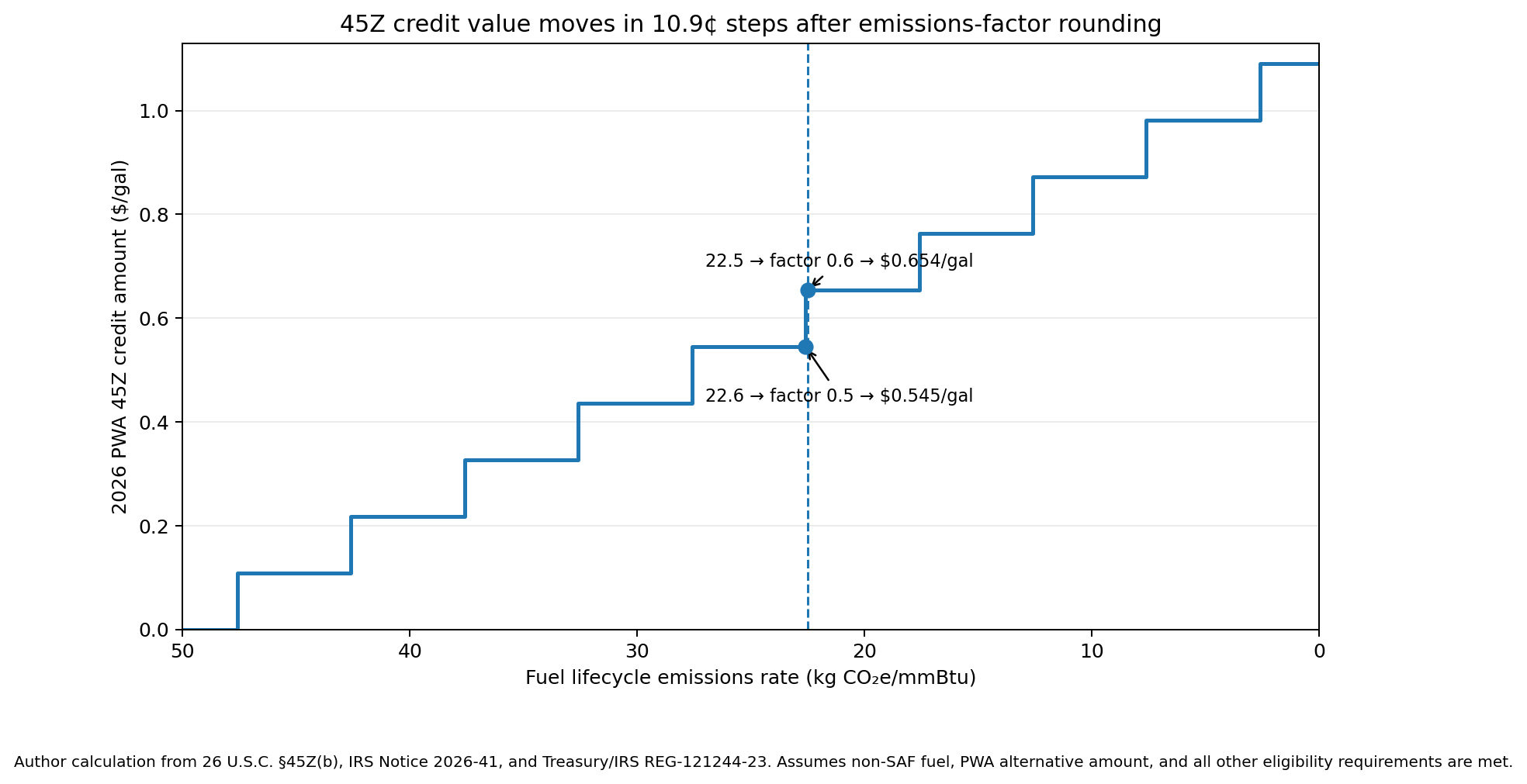
Source: FDCIC.com calculation from 26 U.S.C. §45Z(b), IRS Notice 2026-41, and Treasury/IRS proposed regulations REG-121244-23. Assumes non-SAF fuel, the 2026 PWA alternative amount, and all other eligibility requirements are met.
Start with the formula
For a transportation fuel, Section 45Z defines the emissions factor using the statutory 50 kg CO2e/mmBtu baseline:
Emissions factor = (50 − fuel emissions rate) ÷ 50
The statute then says that if the result is not already a multiple of 0.1, it must be rounded to the nearest 0.1. (26 U.S.C. §45Z)
Treasury's proposed regulations add the operational rounding convention: a 5 in the hundredths place rounds up, and less than 5 rounds down. (Treasury/IRS)
IRS gives a useful example. If the fuel emissions rate is 21.25 kg CO2e/mmBtu:
(50 − 21.25) ÷ 50 = 0.575
0.575 rounds to 0.6. If the emissions rate is 23:
(50 − 23) ÷ 50 = 0.54
0.54 rounds to 0.5. The credit calculation uses the rounded factor.
In 2026, one factor step is worth 10.9 cents
IRS Notice 2026-41 adjusts the 2026 non-SAF PWA alternative amount to $1.09 per gallon. That means:
| Rounded emissions factor | 2026 gross amount per gallon* |
|---|---|
| 0.0 | $0.000 |
| 0.1 | $0.109 |
| 0.2 | $0.218 |
| 0.3 | $0.327 |
| 0.4 | $0.436 |
| 0.5 | $0.545 |
| 0.6 | $0.654 |
| 0.7 | $0.763 |
| 0.8 | $0.872 |
| 0.9 | $0.981 |
| 1.0 | $1.090 |
\*Assumes qualifying non-SAF fuel, PWA requirements are satisfied, and all other Section 45Z requirements are met. This is the statutory credit calculation before considering transfer discounts, transaction costs, tax capacity or other facility-specific issues.
The size of each step is fixed by the rounded factor:
0.1 × $1.09 = $0.109
The emissions-rate width of each band is roughly 5 kg CO2e/mmBtu, because a 0.1 change in the factor corresponds to 5 points on the 50-point statutory baseline. But the important number is the rounding boundary, not the band width by itself.
A 0.1 emissions-rate change can be worth 10.9 cents if it crosses the line
Consider two otherwise identical hypothetical fuel pathways.
Pathway A: emissions rate of 22.6
(50 − 22.6) ÷ 50 = 0.548
0.548 rounds to 0.5. At the 2026 PWA alternative amount:
$1.09 × 0.5 = $0.545 per gallon
Pathway B: emissions rate of 22.5
(50 − 22.5) ÷ 50 = 0.55
0.55 rounds to 0.6 under Treasury's proposed rounding convention. Credit amount:
$1.09 × 0.6 = $0.654 per gallon
The difference is:
$0.654 − $0.545 = $0.109 per gallon
One-tenth of a kg CO2e/mmBtu in this example changes the gross credit amount by 10.9 cents because it happens to cross a rounding threshold. At a hypothetical 100 million qualifying gallons, that difference would equal:
100,000,000 × $0.109 = $10.9 million
That is not a prediction of what any plant will earn. It is a scale illustration of the statutory rounding rule.
The opposite is also true: a real CI improvement can be worth zero additional 45Z dollars
Now consider a facility that improves its fuel emissions rate from 24.5 to 23.0. At 24.5:
(50 − 24.5) ÷ 50 = 0.51 → rounds to 0.5
At 23.0:
(50 − 23.0) ÷ 50 = 0.54 → still rounds to 0.5
The lifecycle emissions rate improved by 1.5 kg CO2e/mmBtu, but the rounded 45Z factor did not move. That does not mean the emissions reduction has no operational, market or environmental value. It means this particular federal credit calculation does not increase until the final pathway crosses the next factor boundary. This is why a universal "dollars per CI point" shortcut can be misleading.
This is a fuel-level cliff, not an FD-CIC cliff
For farmers and low-CI grain programs, this distinction matters. The FD-CIC result itself is not rounded into these 0.1 45Z factor bands.
FD-CIC contributes information about agricultural feedstock emissions. That feedstock result is then incorporated into the applicable lifecycle model used to determine the final fuel emissions rate. The 45Z rounding happens after that final fuel-level calculation.
So it would be incorrect to say:
"Every five points of FD-CIC equals another 10.9 cents of 45Z."
That is not how the system works. The value of a farm-level CI improvement depends on how that improvement changes the final fuel pathway and where that final pathway sits relative to the Section 45Z rounding thresholds.
DOE's current 45ZCF-GREET materials are the appropriate place to evaluate the fuel-level pathway. (DOE 45ZCF-GREET)
The same farm improvement may be worth different amounts to two ethanol plants
This is the commercial implication. Suppose two ethanol plants are evaluating the same lower-CI corn program. One plant's process energy, transportation and other lifecycle inputs leave it just above a 45Z rounding threshold. The second plant sits near the middle of its current factor band.
The same agricultural improvement could push the first facility into the next rounded factor while leaving the second facility in the same band. The underlying farm CI change is identical, but the immediate 45Z value is not.
That helps explain one of the issues highlighted in our earlier review of the University of Illinois farmdoc analysis: an FD-CIC score does not by itself tell a farmer what the resulting 45Z value is worth. The biofuel facility still matters.
Farmer-program economics are therefore not automatically linear
This has practical consequences for low-CI procurement. A buyer designing a farmer program might choose to pay:
- a fixed amount for a practice;
- a per-acre enrollment payment;
- a per-bushel premium;
- an amount based on verified feedstock CI improvement; or
- some negotiated share of downstream value.
None of those structures is required by Section 45Z. And because the fuel-level federal credit moves in rounded factor steps, the buyer's marginal value for another unit of feedstock CI reduction may not be constant.
That does not mean buyers will literally price every farm contract at a rounding threshold. Most plants need portfolios of grain, and actual accounting, inventory and contracting structures are more complicated. It does mean the familiar question of what one CI point is worth does not have a universal answer.
A better question is how close the final fuel pathway is to the next threshold
For a biofuel producer, the economics of a CI-reduction investment should be evaluated against the whole pathway. A lower-CI feedstock, renewable process energy, carbon capture, plant-efficiency project or other intervention may each reduce the final lifecycle emissions rate.
The value of the next increment can depend on:
- the size of the verified emissions reduction;
- the gallons to which it applies;
- whether it moves the final fuel pathway across a rounding threshold;
- whether the fuel and facility satisfy all other 45Z requirements; and
- the value actually realized after any credit transfer or transaction costs.
That is a more complicated calculation than multiplying one farm CI number by a fixed dollar rate. It is also a more accurate one.
The rounding rule is not a loophole. It is part of the statute.
The 0.1 rounding requirement is written into Section 45Z itself. Treasury's proposed regulations explain how to apply the rounding convention, but the existence of the rounding rule is not dependent on the proposed regulation becoming final.
That matters because the staircase effect is not just a modeling curiosity. It is built into the credit formula. For 2026, the size of each PWA step happens to be 10.9 cents per gallon because IRS has set the inflation-adjusted alternative amount at $1.09. If the applicable amount changes with future inflation adjustments, the dollar size of the step changes too. The staircase remains.
What to watch next
The most important next step is not another generic 45Z calculator. It is better visibility into where actual fuel pathways sit relative to the rounded emissions-factor thresholds.
For farmer programs, that would make it easier to distinguish:
feedstock CI improvement
from
incremental 45Z value
Those are connected. They are not interchangeable.
Primary sources
- 26 U.S.C. §45Z
- IRS Notice 2026-41 — 2026 Section 45Z inflation adjustment and applicable amount
- Treasury/IRS — Proposed Section 45Z regulations, REG-121244-23
- DOE — 45ZCF-GREET
Method note: Thresholds and per-gallon values in this article are FDCIC.com calculations from the statutory formula, statutory 0.1 rounding rule and 2026 IRS applicable amount. They are not an IRS-published threshold table.
Tax note: This article is technical market analysis, not tax advice.
Editorial status: This article distinguishes current law/final rules from proposed regulations and author calculations. Dates and regulatory status were checked against primary sources on August 20, 2026.