Carbon capture creates an odd-looking result under the current 45Z framework. From a lifecycle-carbon perspective, capturing fermentation CO2 can be one of the biggest levers an ethanol plant has for lowering its fuel emissions rate. From a tax-credit perspective, claiming the Section 45Q carbon-sequestration credit can also make that same facility ineligible for Section 45Z for that taxable year.
Both statements can be true at once, because lifecycle emissions accounting and federal credit stacking are separate questions. Section 45Z rewards lower-emission fuel, but Congress also wrote an anti-stacking rule into the definition of a qualified 45Z facility, and Treasury's proposed regulations add a critical layer on top of that: how to decide what equipment belongs inside the 45Z "facility." For ethanol plants evaluating CCS, that boundary can matter as much as the CI reduction itself.
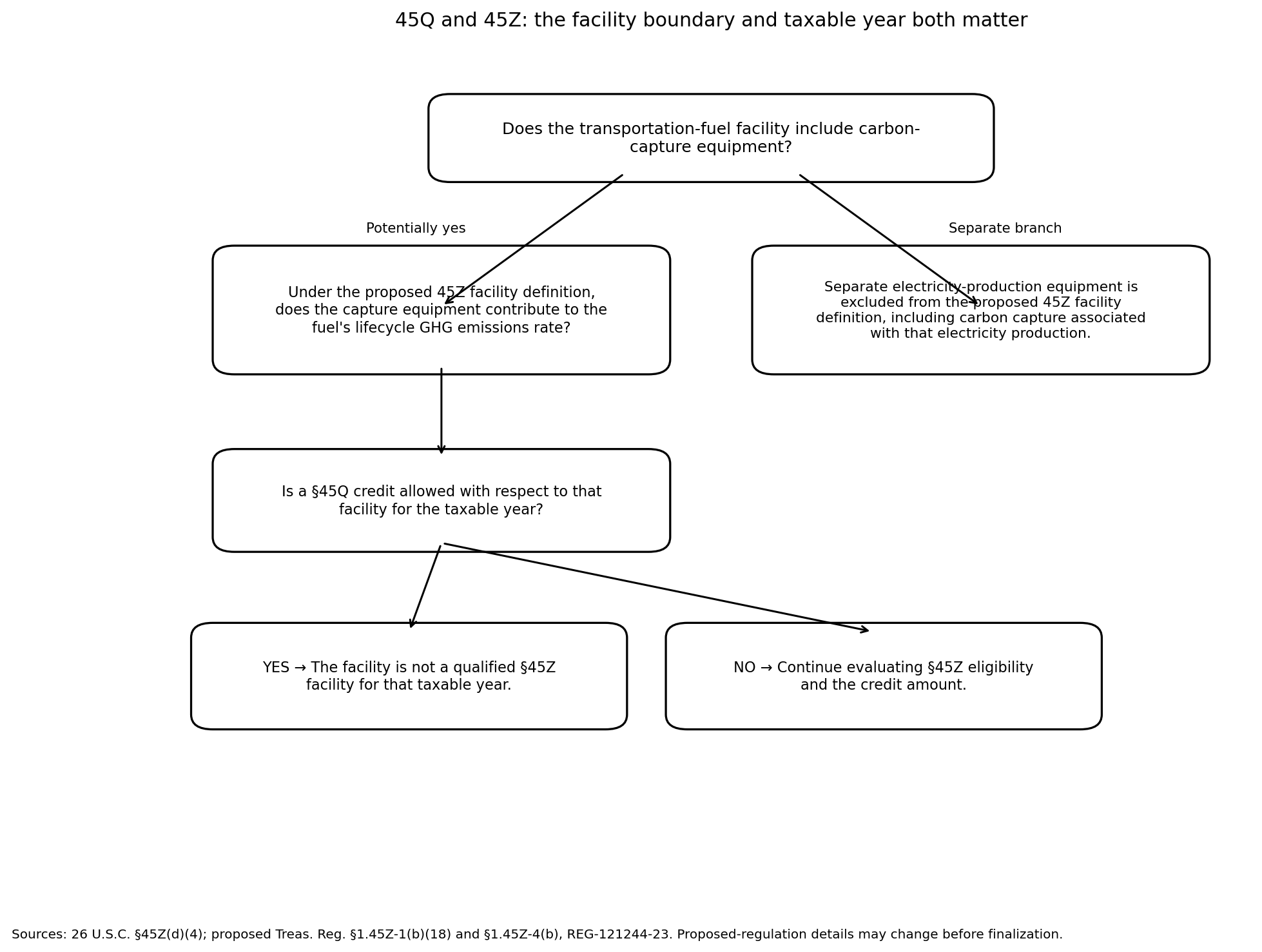
Sources: 26 U.S.C. §45Z(d)(4); proposed Treasury regulations under REG-121244-23. The facility-definition details discussed below are proposed and may change before finalization.
The anti-stacking rule starts in the statute
This part is current law, not merely a Treasury proposal. Section 45Z(d)(4) defines a qualified facility and excludes a facility for which certain other credits are allowed for the taxable year. The list includes Section 45V clean hydrogen, the specified Section 48 hydrogen investment-credit election, and Section 45Q carbon oxide sequestration.
Treasury and IRS summarize the same rule in the proposed 45Z regulations. (Treasury/IRS)
So the basic statement is straightforward:
If a Section 45Q credit is allowed with respect to the same 45Z qualified facility for the taxable year, the facility is not a qualified 45Z facility for that year.
What is less straightforward is defining the facility.
Treasury proposes a single-production-line definition
The proposed regulations would define the 45Z facility around the single production line used to produce the transportation fuel. The proposal says a single production line includes the steps from processing the feedstock through production of the transportation fuel sold in the qualified sale.
For carbon capture, Treasury proposes a specific rule: carbon-capture equipment is included in the facility if that equipment contributes to the lifecycle greenhouse-gas emissions rate used to determine the 45Z credit. That follows the logic of the credit. If the plant uses the CCS reduction to obtain a lower 45Z emissions rate, Treasury's proposal generally treats that capture equipment as part of the production facility for the 45Z analysis. (Proposed regulations)
But not every carbon-capture system at a site is automatically inside the 45Z facility
This is where shorthand can become misleading. It would be wrong to say, "Any CCS at an ethanol site kills 45Z." Treasury's proposed facility definition contains exclusions, and one is particularly important: electricity-production equipment used to power the transportation-fuel production process is excluded, including carbon-capture equipment associated with that electricity-production process.
So the facility boundary depends on what the equipment is doing and how it relates to the fuel-production line. Under the proposal, carbon capture that directly contributes to the fuel's lifecycle GHG rate can be inside the facility, while carbon capture tied to separate electricity-production equipment can be outside it. The tax result therefore cannot be determined from the sentence "the site has CCS."
IRS's own example uses separate taxpayers, and still blocks 45Z for the year
Treasury's proposed regulations include an unusually useful example. Call the fuel producer X and the owner of the capture equipment Y.
During 2025 and 2026:
- X produces transportation fuel at a facility.
- The facility includes carbon-capture equipment.
- Y owns and uses the carbon-capture equipment.
- In 2025, Y captures carbon oxide and claims an allowed Section 45Q credit.
- In 2026, no Section 45Q credit is allowed with respect to the facility.
Treasury's proposed result is:
2025: the facility is not a qualified 45Z facility because a 45Q credit is allowed with respect to it. X cannot claim 45Z for that facility.
2026: no 45Q credit is allowed. Assuming the other requirements are satisfied, the facility can qualify for 45Z.
The example matters for two reasons. First, separate ownership of the capture equipment does not automatically avoid the anti-stacking problem under Treasury's proposed interpretation. Second, the result is taxable-year specific, which makes the issue an annual credit-optimization question rather than a permanent, one-time election between 45Q and 45Z.
Lower CI and higher tax value are not always the same optimization problem
This is the part that matters for project economics. Imagine an ethanol plant considering several ways to lower lifecycle CI: fermentation carbon capture and sequestration, renewable electricity, renewable or lower-carbon process heat, plant-efficiency investments, lower-CI agricultural feedstock, or some combination of these.
From a pure lifecycle model, the plant could rank those options by emissions reduction. From a finance perspective, that ranking is incomplete. A CCS project might create a very large CI reduction, but if the associated equipment sits inside the 45Z qualified facility and a 45Q credit is allowed for that taxable year, the plant also has to account for the anti-stacking rule. A lower-CI feedstock program may create a smaller CI reduction but does not raise the same 45Q stacking issue.
Neither statement means agricultural CI is "better" than CCS. It means the optimal decarbonization portfolio cannot be chosen from a CI chart alone.
This is also why 45Z should not be modeled one lever at a time
Our recent review of 45Z showing up in biofuel earnings documented how producers are beginning to treat CI reduction as an operating and capital-allocation variable. The 45Q interaction shows why that analysis has to be integrated: a plant should not evaluate CCS value and 45Z value as two unrelated spreadsheet tabs.
The questions overlap. Does the capture equipment affect the fuel's lifecycle emissions rate? Does that place the equipment inside the proposed 45Z facility boundary? Is a 45Q credit allowed with respect to the facility in the same taxable year? How much 45Z value would the lower emissions rate create if 45Z is available, and how does that compare with 45Q value? And what other CI-reduction measures remain available without creating the same stacking issue?
That is a project-finance question, a tax question, and a lifecycle-carbon question at the same time.
The farmer-CI connection is indirect but important
This may sound far removed from FD-CIC. It is not. Farmer CI programs exist because lower agricultural emissions can reduce the feedstock contribution to a fuel pathway, and if the facility is choosing among several ways to reduce lifecycle CI, low-CI feedstock is one of the available levers.
The value the plant places on that lever depends on the rest of the facility. A plant with CCS may have a very different marginal value for lower-CI corn than a plant without CCS, and a plant choosing 45Q in a particular year may have different 45Z economics than one relying heavily on feedstock and process-energy reductions. As our 45Z rounding analysis shows, the value can also depend on where the final fuel emissions rate falls relative to the statutory factor thresholds.
This is why a farmer cannot determine a universal "45Z value per CI point" from the FD-CIC score alone. The buyer's facility and tax strategy still matter.
What is final and what is proposed
This article needs one line drawn very clearly.
Current law
Section 45Z contains the anti-stacking rule. A qualified 45Z facility excludes a facility for which Section 45Q is allowed for the taxable year.
Proposed Treasury interpretation
The detailed facility definition, including when carbon-capture equipment is included in the single production line and the examples applying that definition, is in proposed regulations. Those proposed rules are not final. A company making a material tax decision should not rely on this article, or on a simplified summary, as a substitute for tax counsel and the final regulations when issued.
CCS can still be extremely valuable
The anti-stacking rule should not be read as an argument against carbon capture. CCS can materially lower lifecycle ethanol emissions, and Section 45Q can also create substantial federal value for qualifying sequestration.
The point is narrower: a CI reduction and the tax credit used to monetize that reduction are not the same thing. Section 45Z forces producers to evaluate the whole package. For some plants, 45Q may be the better answer in a given year; for others, 45Z may be more valuable; for others still, the best strategy may depend on facility boundaries, ownership structures, operating dates, and the mix of other CI-reduction investments. That is exactly why "CCS lowers CI" is only the beginning of the analysis.
What to watch next
The final Treasury definition of a Section 45Z facility is the key item to track. Until then, the safest way to discuss the issue is this:
A Section 45Q credit allowed with respect to the same 45Z qualified facility can disqualify that facility from 45Z for the taxable year. Treasury's proposed regulations explain how carbon-capture equipment would be treated in the facility boundary, but those details are not yet final.
That sentence is less dramatic than "you cannot stack 45Q and 45Z." It is also more accurate.
Primary sources
- 26 U.S.C. §45Z
- Treasury/IRS — Proposed Section 45Z regulations, REG-121244-23
- IRS — Clean Fuel Production Credit
- DOE — 45ZCF-GREET
Tax note: This article is technical market analysis, not tax advice. The detailed Section 45Z facility-definition provisions discussed above are proposed regulations and may change.
Editorial status: This article distinguishes current law/final rules from proposed regulations and author calculations. Dates and regulatory status were checked against primary sources on August 20, 2026.