The easy version of this story is that 45Z made biofuel feedstocks "domestic," but that is not quite right.
For transportation fuel produced after December 31, 2025, the Clean Fuel Production Credit requires the fuel to be exclusively derived from feedstock produced or grown in the United States, Mexico or Canada. (IRS)
At the same time, EPA's final Renewable Fuel Standard for 2026 and 2027 requires historically large volumes of biomass-based diesel. EPA expects domestic feedstocks to supply most of that production, but not all of it. In the agency's own analysis, 25% to 30% of the feedstocks used to produce biomass-based diesel in 2026 and 2027 are projected to be imported. (EPA Response to Comments)
That creates an unusual market structure. Canada and Mexico are foreign suppliers, but for 45Z feedstock-origin purposes they sit inside the preferred sourcing region. Feedstocks from outside North America can still enter U.S. biofuel markets, but they do not have the same federal 45Z treatment.
The result is not a wall around North America. It is a meaningful new sourcing advantage.
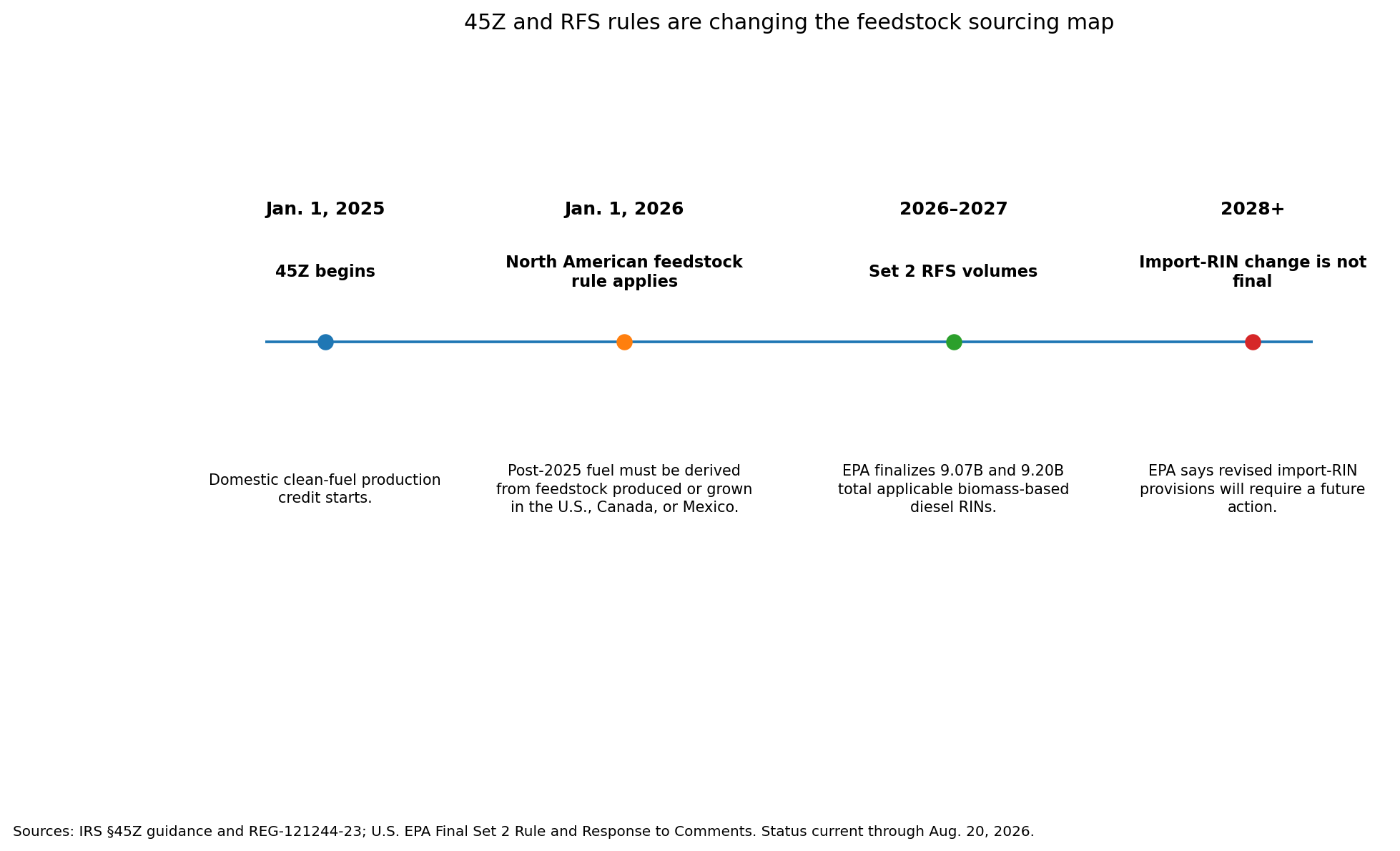
Sources: IRS Section 45Z guidance and proposed regulations; U.S. EPA final Set 2 RFS rule and Response to Comments. Status current through August 20, 2026.
What changed for fuel produced in 2026
The origin rule is now straightforward at the statutory level: for transportation fuel produced after December 31, 2025, qualifying 45Z fuel must be exclusively derived from feedstock produced or grown in:
- the United States;
- Canada; or
- Mexico.
Treasury and IRS repeat the requirement in their proposed 45Z regulations. They also make clear that feedstock origin is not just a label on the final shipment. For imported used cooking oil, for example, Treasury says a feedstock is considered foreign if the underlying source and/or the aggregator is located outside the United States, Canada or Mexico. (Treasury/IRS proposed regulations)
Treasury is still considering how taxpayers should substantiate Canadian and Mexican feedstock origin, including UCO. That recordkeeping question matters because a North American invoice is not necessarily the same thing as evidence that all of the underlying feedstock originated inside the eligible region, and that is a traceability problem, not just a trade-policy problem.
The RFS is pulling in the opposite direction: it needs more feedstock
While 45Z narrows the origin that qualifies for the federal clean-fuel tax credit, EPA's final Set 2 rule increases renewable-fuel demand.
EPA's total applicable biomass-based diesel volumes, including the agency's 70% reallocation of certain small-refinery exemptions, are:
| RFS category | 2026 | 2027 |
|---|---|---|
| Biomass-based diesel | 9.07 billion RINs | 9.20 billion RINs |
| Advanced biofuel | 11.10 billion RINs | 11.32 billion RINs |
| Total renewable fuel | 26.81 billion RINs | 27.02 billion RINs |
That creates the central tension in the market:
45Z gives a stronger tax advantage to North American feedstock origin at the same time the RFS requires enough renewable fuel that U.S. feedstocks alone are not expected to cover the full requirement.
EPA says exactly that in its response to comments: the agency projects that roughly 70% to 75% of the feedstocks used to produce biomass-based diesel in 2026 and 2027 will come from domestic U.S. sources, with the remaining 25% to 30% expected to be imported, which raises the question of where those imports come from.
EPA expects much of the imported feedstock to come from Canada and Mexico
EPA's answer is unusually direct: the agency says much of the imported feedstock it projects for 2026 and 2027 is expected to come from Canada and Mexico because those feedstocks can be used to produce biofuels eligible for the 45Z credit. (EPA Response to Comments)
EPA also estimates that only about 8% of the BBD supplied to meet the 2026 volumes and 9% in 2027 will be produced from feedstocks imported from outside North America.
Those estimates contain a conservative assumption: EPA treats all projected imported fats, oils and greases in the calculation as coming from outside North America, while treating imported canola oil as coming from Canada and Mexico.
The exact feedstock mix will move with prices and policy. EPA says so itself. But the direction of the sourcing advantage is clear enough to visualize.
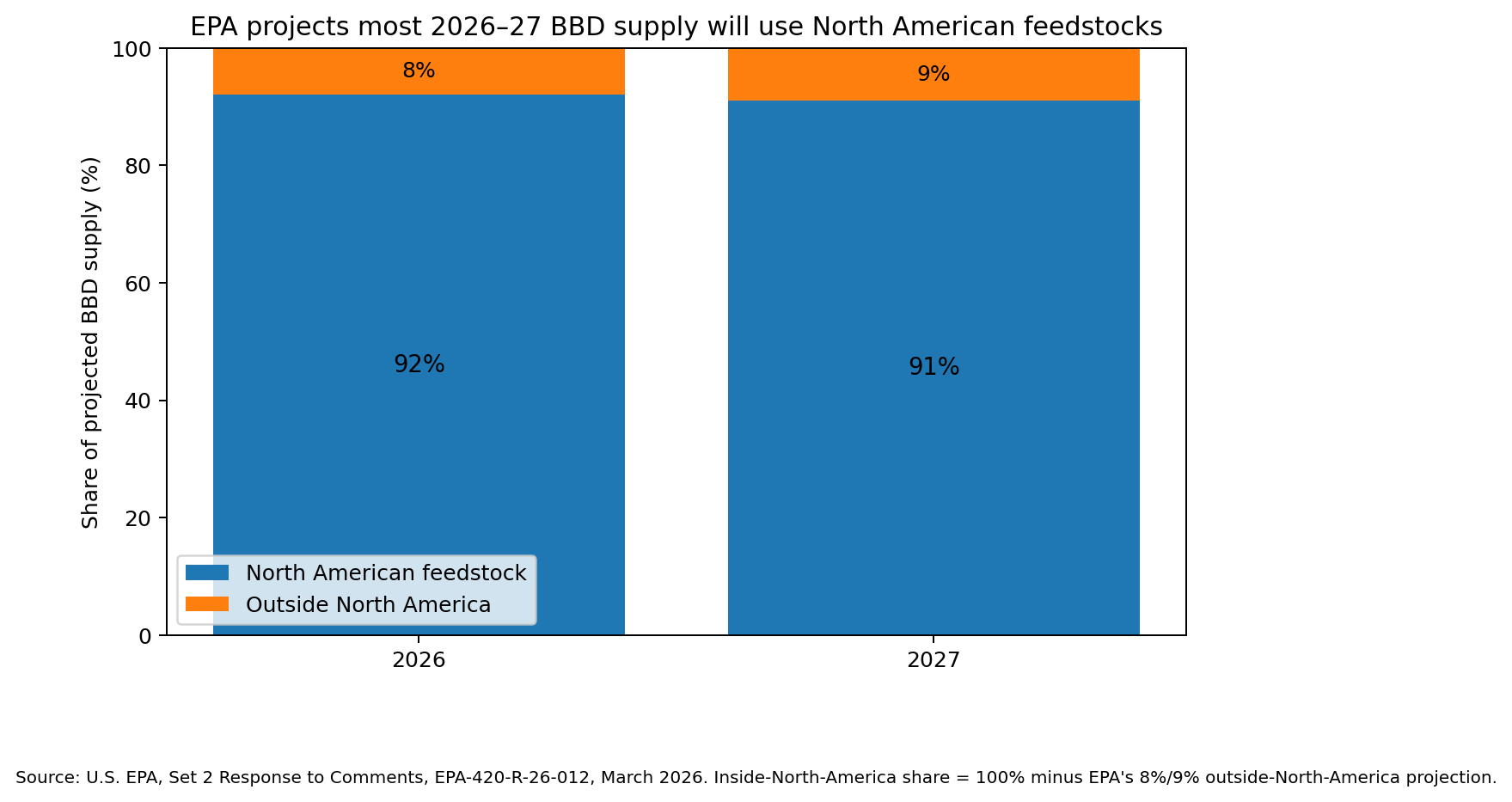
Source: U.S. EPA, Set 2 Response to Comments, EPA-420-R-26-012, March 2026. The North American share shown above is calculated as 100% minus EPA's projected 8% and 9% outside-North-America shares.
This does not mean 92% of feedstock will be U.S.-grown. EPA separately projects only 70% to 75% domestic U.S. feedstock. The difference is the role of Canada and Mexico, and that distinction is the story.
Canada may be the clearest example
Canola is a useful case study because the supply response is already visible.
USDA's August 2026 Oil Crops Outlook forecasts Canadian rapeseed/canola crush at a record 13.7 million metric tons for the 2026/27 marketing year, up 1 million metric tons from the revised prior-year level. USDA points to both larger supplies and expanded crushing capacity. (USDA ERS)
Two recent capacity developments stand out in the report:
- Louis Dreyfus expanded its Yorkton, Saskatchewan, canola complex to more than 2 million metric tons of annual crush capacity.
- Cargill opened its Regina facility in April 2026, adding roughly 1 million metric tons of processing capacity.
Canada therefore combines several advantages at once:
- large canola production;
- expanding crush capacity;
- geographic proximity to U.S. renewable-diesel markets; and
- feedstock origin that remains inside the post-2025 45Z sourcing rule.
That does not guarantee Canadian canola oil will always beat soybean oil, corn oil, tallow or UCO on delivered economics. It does explain why North American canola has become strategically important.
Feedstocks from outside North America are not banned
This point is worth stating plainly because "45Z feedstock restriction" can easily turn into "foreign feedstocks are prohibited." They are not prohibited from the U.S. biofuel market. The issue is whether the fuel produced from them qualifies for 45Z under the post-2025 feedstock-origin rule.
EPA specifically expects some feedstocks from outside North America to remain economically competitive. The agency points to state clean-fuel programs such as California's LCFS and similar programs in Oregon, Washington and New Mexico, where some lower-CI waste feedstocks can earn substantial value.
That means a biofuel producer may be balancing several markets at once:
45Z rewards qualifying clean fuel and now favors North American feedstock origin.
RFS creates federal renewable-fuel volume demand.
State clean-fuel programs can place additional value on very low-CI feedstocks.
Commodity and freight markets determine what feedstock actually arrives at the plant at an acceptable price.
A feedstock that is disadvantaged for one federal incentive can still be valuable under another program.
One correction that matters: the proposed 50% import-RIN reduction is not final
EPA has publicly said it intends to give imported renewable fuel and fuel made from certain foreign feedstocks reduced RFS compliance value beginning in 2028, but that policy should not be described as final today.
In the final Set 2 Response to Comments, EPA states that it did not finalize the proposed import-RIN reduction provisions in this action. The agency says it intends to consider the comments and finalize revised provisions in a future action, and that status distinction is important for any company making sourcing or capacity decisions now. (EPA Response to Comments)
The current structural advantage is already significant because of 45Z, and a future import-RIN rule could add another layer, though the final details are not yet in place.
The sourcing map is changing before the supply chain is finished adapting
EPA says it has already observed a major change in fuel flows: imports of biomass-based diesel fell by about 80% in 2025 compared with 2024. In its final-rule analysis, the agency says 45Z changes give domestically produced BBD a strong advantage over imported BBD.
Feedstock, though, is more complicated. EPA still expects imported feedstock to be necessary, and it expects Canada and Mexico to supply much of it.
That means the emerging U.S. biofuel market is not simply becoming "domestic." It is becoming more North American.
For agriculture, that shifts the competitive set: U.S. soybean oil is competing with Canadian canola oil inside the same 45Z-eligible origin region. Corn oil and domestic fats compete on their own economics and CI. Imported waste oils from outside North America may still find a home where state clean-fuel credits make them attractive. The result is a feedstock market increasingly sorted by both origin and carbon intensity.
That is a very different market from the one biofuel producers were buying into only a few years ago.
What to watch next
Three items matter most:
- Treasury/IRS final recordkeeping rules for Canadian and Mexican feedstock origin.
- Actual 2026 import data for Canadian canola oil, UCO and other fats/oils/greases.
- EPA's future action on revised import-RIN provisions.
Until that third item is final, any statement that foreign feedstocks will automatically receive half-value RINs in 2028 is premature.
Primary sources
- IRS — Clean Fuel Production Credit
- Treasury/IRS — Proposed Section 45Z regulations, REG-121244-23
- DOE — 45ZCF-GREET
- EPA — Final Renewable Fuel Standards for 2026 and 2027
- EPA — Set 2 Response to Comments, EPA-420-R-26-012
- USDA ERS — Oil Crops Outlook: August 2026
Editorial status: This article distinguishes current law/final rules from proposed regulations and author calculations. Dates and regulatory status were checked against primary sources on August 20, 2026.