This time the evidence is not coming from an earnings call. U.S. biofuel plants used 1.434 billion pounds of soybean oil in May 2026, the highest monthly value in the U.S. Energy Information Administration's current series. That was up from 1.224 billion pounds in April and 1.283 billion pounds in March, and the EIA series begins in 2021. (EIA)
That makes the latest data a useful companion to the processor results we have already been tracking. ADM and Bunge have both pointed to stronger biofuel-linked soybean-oil economics in 2026, and the EIA numbers show the physical demand underneath those margins: more soybean oil is actually moving into biofuel production.
The more interesting detail is where the May increase came from. Renewable diesel plants accounted for roughly 71% of the month-over-month increase in reported soybean-oil use. Biodiesel plants increased their use too, but much less sharply.
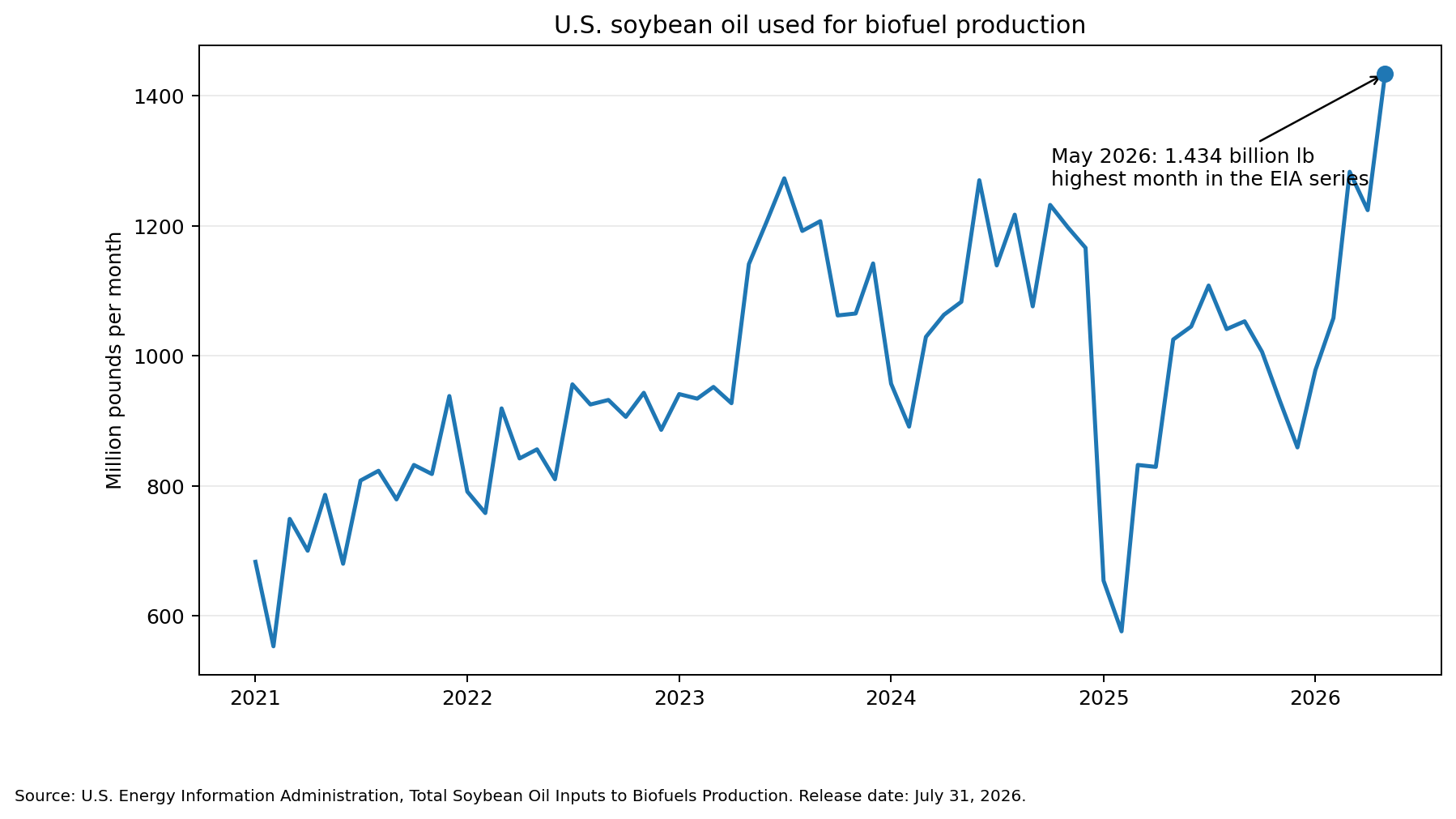
Source: U.S. Energy Information Administration, Total Soybean Oil Inputs to Biofuels Production. Release date: July 31, 2026.
May was not just a record, it was a 17% one-month jump
From April to May, total soybean-oil use in biofuel production increased by 210 million pounds:
1.434 billion lb − 1.224 billion lb = 210 million lb
That is a 17.2% increase in one month.
The history matters. In 2021 and 2022, monthly soybean-oil use was generally below 1 billion pounds. The series first moved above 1 billion more consistently in 2023, remained elevated through much of 2024, then fell sharply early in 2025 before rebounding. By May 2026, it had moved above every previous monthly reading.
That does not prove a permanent new floor for soybean-oil demand. One month is one month, and feedstock economics can move quickly. But the record is consistent with what processors have been telling investors: the oil side of the soybean is carrying more value as biomass-based diesel demand strengthens.
For context, our earlier analysis of Bunge and ADM crush economics looked at the same market from the processor's income statement. This EIA release looks at it from the feedstock tank.
Renewable diesel drove most of the increase
EIA separates soybean-oil use at biodiesel plants from soybean-oil use at renewable diesel plants. The April-to-May change was:
| Soybean oil use | April 2026 | May 2026 | Change |
|---|---|---|---|
| Biodiesel plants | 686 million lb | 747 million lb | +61 million lb |
| Renewable diesel plants | 537 million lb | 687 million lb | +150 million lb |
| Total | 1.224 billion lb | 1.434 billion lb | +210 million lb |
Because EIA reports rounded monthly values, the plant categories do not add perfectly to the rounded total in every period, but the directional result is still clear. Renewable diesel plants increased soybean-oil use by 27.9% from April to May, while biodiesel plants increased use by 8.9%. Using the rounded values, renewable diesel accounted for about 71% of the total month-over-month increase.
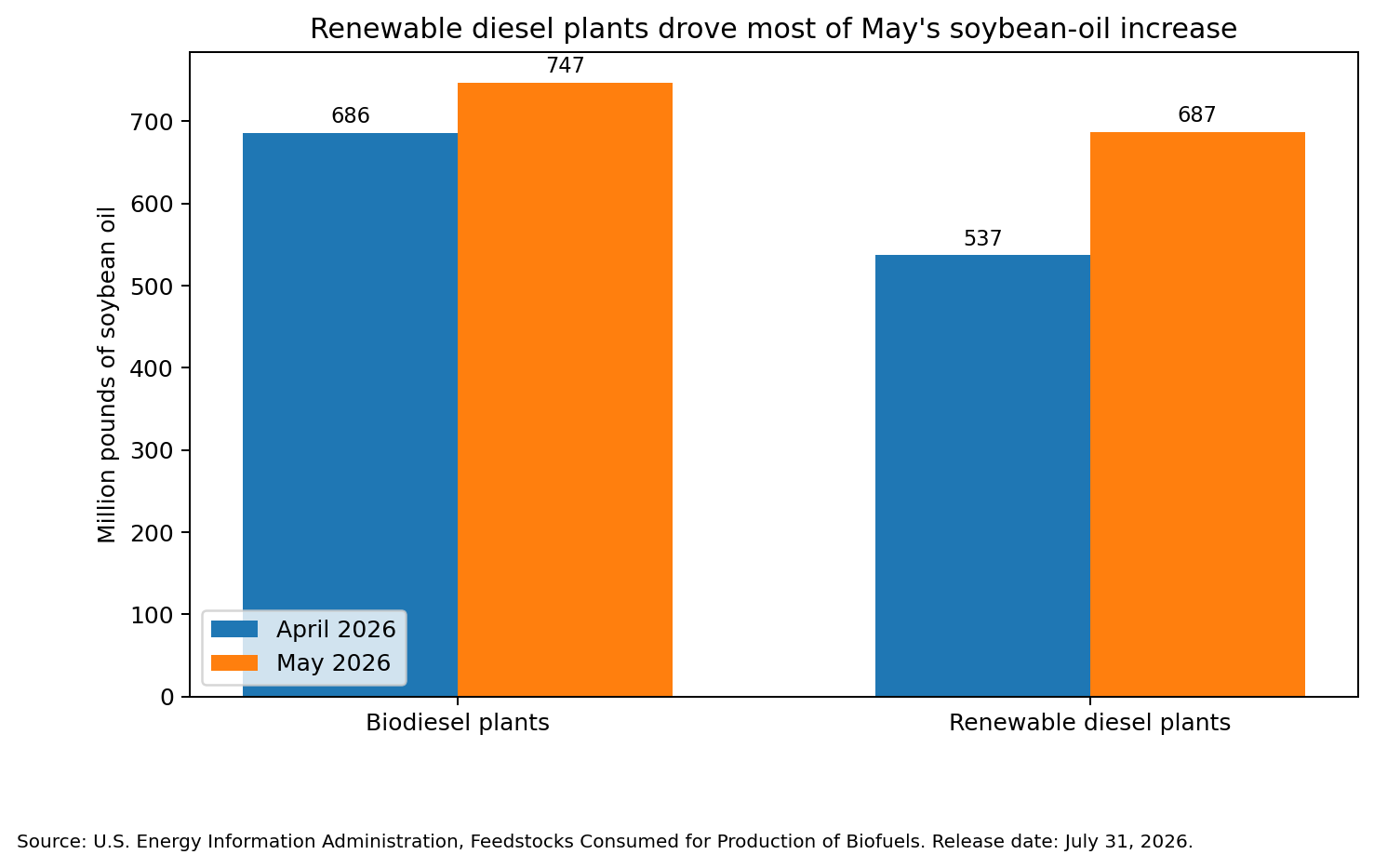
Source: U.S. Energy Information Administration, Feedstocks Consumed for Production of Biofuels. Release date: July 31, 2026.
That distinction matters because "biofuel demand for soybean oil" is often discussed as a single market. It is not. Biodiesel and renewable diesel have different plants, operating economics and growth trajectories. In May, both used more soybean oil, but the larger incremental pull came from renewable diesel.
Soybean oil is not winning because every other feedstock disappeared
The May data also argue against another oversimplification. Soybean oil was not the only major feedstock moving into biofuels. EIA reported May consumption of:
- 796 million pounds of tallow
- 605 million pounds of yellow grease
- 457 million pounds of corn oil
- 293 million pounds of canola oil
- 1.434 billion pounds of soybean oil
USDA's August Oil Crops Outlook puts the same numbers into a broader frame. USDA says total reported feedstock use reached a monthly record of 3.6 billion pounds in May, and that soybean oil accounted for 39% of feedstock use for feedstock-based biofuel production that month, two percentage points more than in April. (USDA ERS) At the same time, the share represented by animal fats, used cooking oil and grease increased from 35% in April to 40% in May.
So this is not a story about soybean oil eliminating lower-cost waste fats or every competing vegetable oil. It is a story about a large biomass-based diesel market pulling on several feedstock pools at once, and that competition is exactly why soybean processors care so much about renewable-fuel policy. Soybean oil does not need to become the only feedstock to materially change the economics of crushing soybeans.
USDA is now building stronger oil demand into the soybean outlook
USDA's August outlook raised its estimate of soybean-oil biofuel use for the 2025/26 marketing year to 14.7 billion pounds, while its 2026/27 forecast remains 17.8 billion pounds. (USDA ERS) USDA also raised its 2026/27 U.S. soybean-crush forecast to a record 2.78 billion bushels. The agency says strong demand for soybean meal and oil is supporting record crush.
That connection matters. A renewable diesel plant does not buy a soybean, it buys oil. But the demand for the oil changes the economics of the crush plant that buys the soybean: when the value of oil rises relative to the bean, crushers have more incentive to run capacity, expand capacity, or bid more aggressively for local soybeans. That is the mechanism behind the capacity story we covered when ADM announced plans to expand soybean crush at four U.S. plants.
The May EIA record does not tell us how much of that planned expansion will ultimately be justified by biofuel demand. It does make the demand case harder to dismiss as a policy forecast.
What this says about 45Z, and what it does not
It would be easy to turn this into a claim that 45Z caused record soybean-oil use. The public data do not support that conclusion by themselves. Several forces are working at once: higher RFS biomass-based diesel requirements; 45Z economics; state clean-fuel programs; relative prices among soybean oil, canola oil, corn oil, tallow and used cooking oil; renewable-diesel operating rates; and normal commodity-market supply and demand. EIA reports what plants consumed. It does not assign causation to one policy.
The same caution applies upstream. The record does not show that farmers growing lower-CI soybeans are receiving a premium. It does not show that the soybeans behind May's oil volumes were enrolled in a farmer CI program, and it does not establish that one farming practice is responsible for the demand. Those are separate questions. What the data do show is that the biofuel market's demand for soybean oil is physically large enough to matter to the agricultural value chain.
The next question is whether feedstock demand becomes feedstock differentiation
The soybean market has already moved through one important transition. Biofuel demand changed the value of soybean oil. Stronger oil economics changed crush margins. Stronger crush margins are now helping support investment in additional processing capacity.
The next transition is more specific: whether low-CI fuel markets begin to differentiate among feedstocks based on how they were produced. That is where 45Z, FD-CIC and farmer-facing CI programs come in. A stronger market for soybean oil can create the commercial backdrop for farmer programs, but it does not automatically determine the value of a reduced-CI soybean or how that value will be shared. For farmers, those questions still depend on the buyer, the fuel pathway, the program contract, the applicable CI methodology, and the records required to support the claim.
The physical demand, however, is no longer hypothetical. May's EIA data put a new number on it: 1.434 billion pounds of soybean oil in one month.
What to watch next
EIA's next monthly feedstock release is scheduled for August 31, 2026. If June exceeds May, the record will move again. If it pulls back, May will remain useful as a high-water mark rather than evidence of a straight-line trend.
FDCIC.com will continue to separate three questions that are often blended together:
- Is biofuel demand increasing the value of agricultural feedstocks?
- Is a specific lower-CI feedstock worth more to a specific fuel producer?
- How much of that value is actually being offered back to the farmer?
The first question is increasingly easy to document. The second and third still require program-specific evidence.
Primary sources
- U.S. EIA — Total Soybean Oil Inputs to Biofuels Production
- U.S. EIA — Feedstocks Consumed for Production of Biofuels
- USDA ERS — Oil Crops Outlook: August 2026
Editorial status: This article distinguishes current law and final rules from proposed regulations and author calculations. Dates and regulatory status were checked against primary sources on August 20, 2026.