Part 1 of a 5-part FDCIC series on S&P Global Energy's June 2026 report, Fueling agriculture: biofuels as the catalyst.
For most of the modern biofuel era, agriculture's relationship to fuel policy has been simple: more demand for corn and soybeans. Ethanol built a market for corn starch. Biodiesel and renewable diesel expanded demand for vegetable oil. Farmers benefited because these markets bought more of what they were already growing.
A newer set of carbon-intensity-based fuel policies is trying something different. Instead of valuing a bushel only for its starch or oil content, these programs can also assign value to how it was grown and what that means for the finished fuel's lifecycle emissions. S&P Global Energy's June 2026 report, Fueling agriculture: biofuels as the catalyst, argues this is where low-CI and reduced-CI feedstock markets come from, and it's worth pulling apart what the report actually says versus what still has to be built before a farmer sees a check.
Biofuel policy has shifted priorities before
S&P frames biofuel policy as a series of overlapping priorities rather than one fixed mission. Early programs were tied to creating markets for surplus crop production. Energy security took on more weight during periods of oil-price volatility. Environmental goals became more prominent as greenhouse gas accounting matured. The report argues the market is now entering a phase where agriculture needs new markets that connect decarbonization to farm economics.
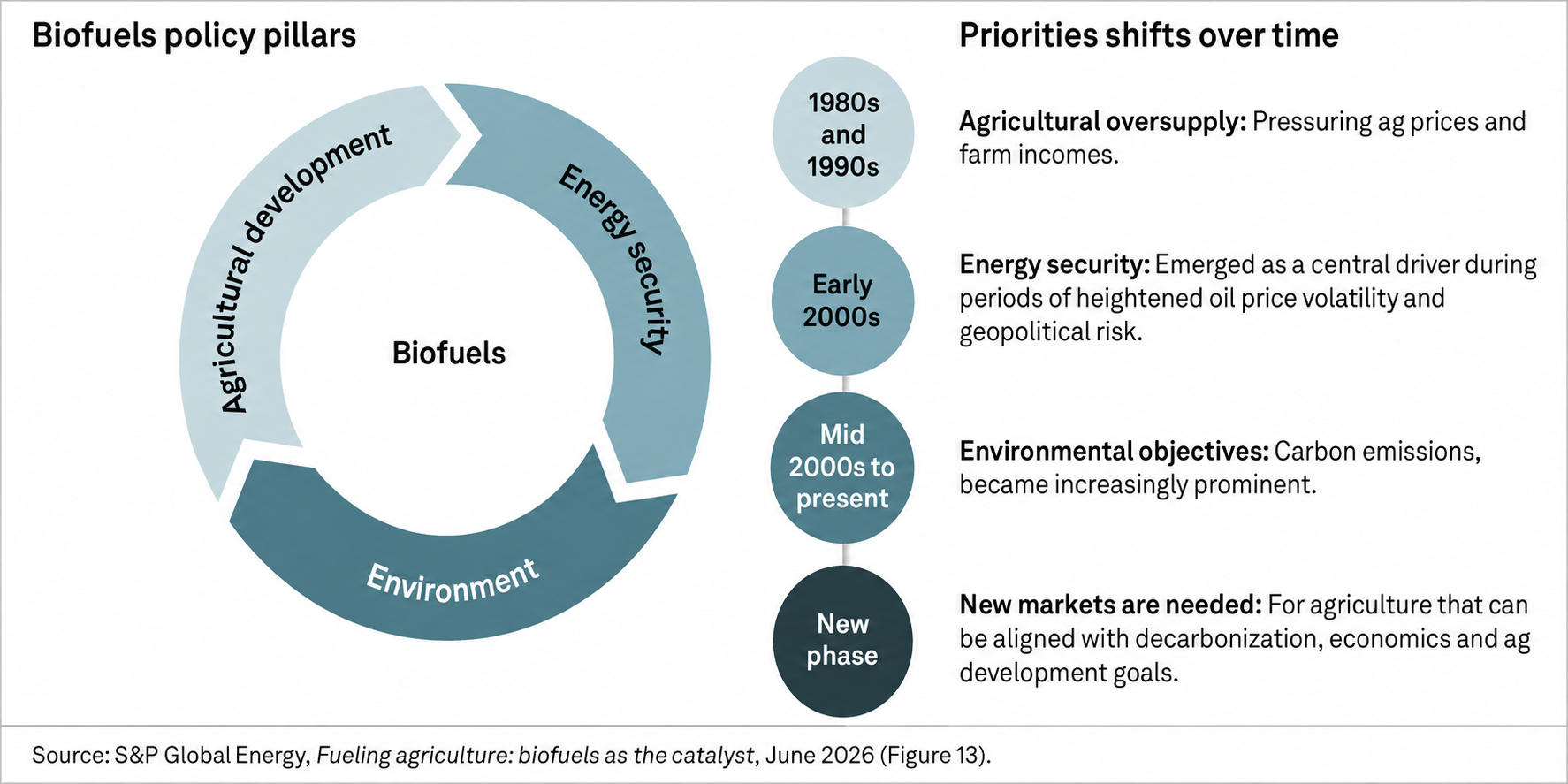
Source: S&P Global Energy, Fueling agriculture: biofuels as the catalyst, June 2026, Figure 13.
The mechanism matters as much as the stated goal. A volumetric mandate creates value by requiring more gallons of renewable fuel, and more gallons generally means more feedstock demand, full stop. A carbon-intensity market works differently: it can pay more for a lower-emissions gallon than a higher-emissions one, which means the emissions associated with the feedstock itself become economically relevant to whoever is producing the fuel. Under that structure, a crop stops being measured only in bushels or tons and starts carrying a carbon-intensity attribute too.
Emerging frameworks reward lower-GHG fuels
S&P contrasts traditional blending mandates, which have supported farm demand and returns without differentiating sustainability performance, against carbon-intensity-driven frameworks like the IRA's Section 45Z Clean Fuel Production Credit, which reward lower-GHG fuels and, in the report's telling, begin to recognize agriculture's role in emissions reduction. Jessica Monserrate, Head of Sustainability North America at BASF, put it this way in the report: "IRA Section 45Z marks the first time federal policy explicitly links farm level carbon performance to direct financial value..."
Historically, a farmer's economic exposure to biofuel policy has run through the commodity market: more ethanol demand, more corn demand, and whatever that does to price. A CI-based market opens up something closer to a direct line from farm production to feedstock carbon intensity to fuel carbon intensity to downstream economic value. That doesn't mean every low-CI acre earns a premium automatically. It means carbon performance can now be part of the value equation at all, which wasn't true before.
What counts as a low-CI feedstock
A low-CI feedstock, at a conceptual level, is a commodity whose production results in lower lifecycle greenhouse gas emissions than the baseline a given fuel program uses for comparison. S&P notes emissions vary by feedstock and farming practice, and it points to agricultural productivity and climate-smart practices as potential contributors to lower lifecycle emissions.
That creates a real distinction between two loads of corn that would otherwise look identical at the elevator. Both might meet the same commodity specifications, but if the lifecycle accounting framework recognizes a difference in how each was produced, the two loads may not contribute the same amount to a biofuel facility's finished-fuel CI. The physical grain stays fungible; the carbon-intensity information attached to it doesn't have to.
The value doesn't get created on the farm alone
It's tempting to jump straight from "lower farm CI" to "farmer premium," but there are several steps in between that the report doesn't spell out. For reduced-CI agriculture to create value in a biofuel market, a modeled emissions result has to connect to an eligible quantity of feedstock, move through the supply chain with that information intact, and reach a biofuel producer who can use it inside the applicable accounting framework. Only then does a lower fuel CI translate into economic value, and only after that do commercial agreements decide how that value gets split.
S&P doesn't provide the chain-of-custody or program-specific accounting rules needed to make that work today. What it does establish is the economic direction: carbon-intensity policy can send a market signal upstream into agriculture, even before the mechanics of any one program are settled.
California already prices carbon-differentiated feedstock
The report points to California's Low Carbon Fuel Standard as a working example, crediting it with raising soybean demand by rewarding low-CI feedstocks with a premium. It also cites Brazil's RenovaBio program, which rewards biofuels for lifecycle GHG reductions. Both matter because they show a fuel market treating renewable fuel, and the feedstock behind it, as something other than economically identical across the board. Once lifecycle emissions affect price, upstream production choices start to matter to the buyer, not just to a sustainability report.
A farmer CI score isn't a carbon credit
This distinction is going to matter more as farmer-facing programs develop. A reduced-CI crop isn't automatically a standalone carbon offset. The value, where it exists, comes from the crop changing the lifecycle emissions of a downstream product: the farmer supplies the commodity, the biofuel facility produces the qualifying fuel, and the farm-level emissions data can affect that fuel's environmental performance and, potentially, its economic value.
That has design implications. A credible low-CI feedstock program needs to answer what agricultural information it requires, how it calculates the CI outcome, what quantity of crop that outcome covers, how the information survives aggregation and transfer, which downstream market recognizes the lower CI, and how and when value flows back to the grower. Those questions sit across agronomy, lifecycle accounting, traceability, verification, tax policy, and commodity procurement, and no single actor answers all of them alone.
What this changes and what it doesn't
Biofuels have already shown they can build large new agricultural markets by buying more of a crop. The next phase the report describes is less about buying more and more about buying feedstock with characteristics that improve a fuel's lifecycle performance. If that holds, the question shifts from how many bushels a market wants to which bushels create the most value for a given fuel pathway, and the answer increasingly depends on what happened on the farm before the crop ever left it.
None of that is settled yet. The S&P report lays out the market logic; it doesn't establish current eligibility, calculation, verification, or chain-of-custody rules for any specific 45Z or agricultural CI program. Those still need to be checked against the applicable current guidance before anyone treats them as fixed.