Part 5 of a 5-part FDCIC series on S&P Global Energy's June 2026 report, Fueling agriculture: biofuels as the catalyst.
The traditional food-versus-fuel argument starts from a simple assumption: more crops for fuel means more land devoted to fuel instead of food. S&P Global Energy's 2026 report, Fueling agriculture: biofuels as the catalyst, pushes back on that framing. Its central claim is that agricultural productivity can rise much faster than land use, and that stronger biofuel demand could help create the economic incentive for farmers to invest in the technology needed to produce more from the land already in production. The report is careful to call its optimized scenarios conditional outcomes, dependent on sustained innovation, technology adoption, and market incentives, not forecasts. Even so, they're useful for showing how much the food-versus-fuel math changes once productivity is allowed to move.
Nearly 50% more corn on slightly less acreage
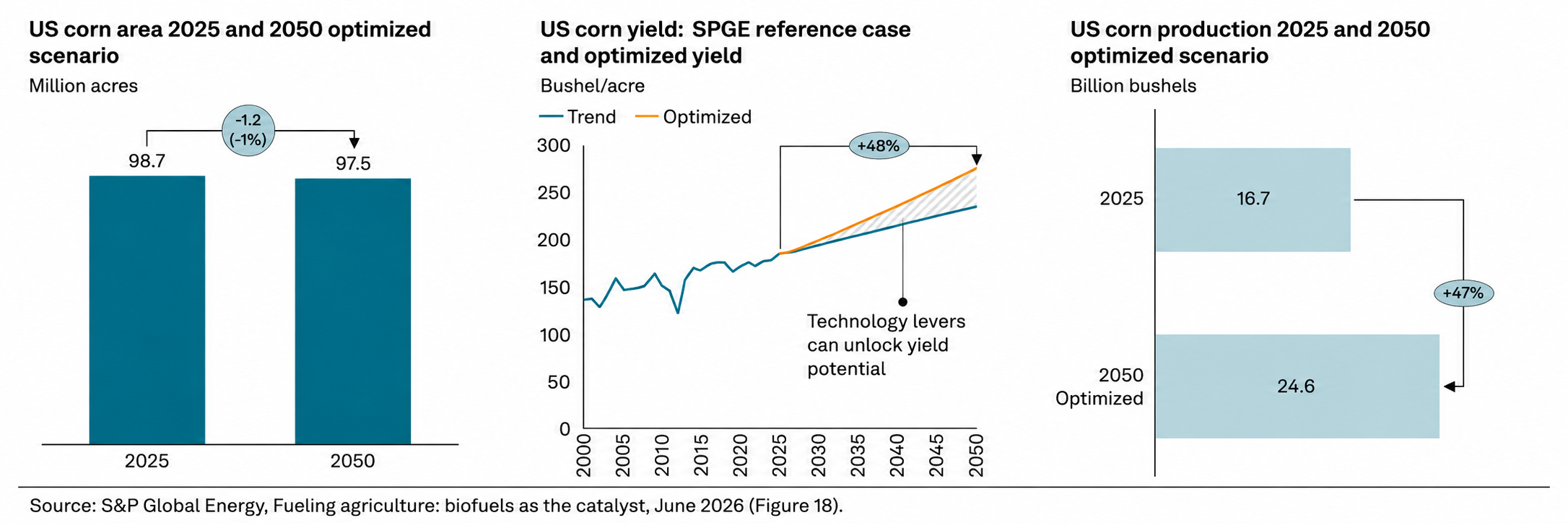
Figure 18 is probably the clearest illustration in the report. S&P's optimized U.S. corn scenario compares 2025 with 2050.
Source: S&P Global Energy, Fueling agriculture: biofuels as the catalyst, June 2026, Figure 18.
In the scenario, U.S. corn area declines slightly, from 98.7 million acres to 97.5 million acres, while optimized yield rises enough that total corn production increases from 16.7 billion bushels to 24.6 billion bushels. That's roughly 47% more corn production on about 1% less acreage. S&P states plainly that reaching this outcome requires strong market signals and enough farmer incentive to justify adopting yield-enhancing technology; it isn't something that happens on its own. What the scenario demonstrates is that acreage and production don't have to move together.
Productivity changes the food-versus-fuel equation
A static view of agriculture assumes every additional unit of biofuel feedstock has to come from an existing use or new land. A productivity-driven system adds a third option: more output per acre. S&P attributes the next wave of agricultural productivity to stacked technologies, including seed innovation, improved crop nutrition, precision management, digital tools, and AI-enabled analytics. In its broader optimized scenario, the report estimates that about 82% of additional output comes from higher yields rather than land expansion. If demand encourages the investment behind that, the system can respond by intensifying output rather than simply planting more acres.
The report is careful to flag this as a scenario, not a baseline
This distinction is worth keeping. S&P defines optimized yield as conditional on sustained innovation and technology-adoption incentives, and it specifies that the concept assumes a market-demand and policy structure capable of encouraging both agricultural demand and yield expansion. It also constrains land expansion in environmentally sensitive areas and assumes growth comes primarily from intensification and closing yield gaps rather than converting new ground. So Figure 18 shouldn't be read as saying U.S. corn production will reach 24.6 billion bushels in 2050. It shows what S&P believes could be possible under a high-adoption, high-incentive scenario, which is a narrower and more defensible claim than a prediction.
Biofuel feedstock doesn't leave the food system entirely
Simplified food-versus-fuel comparisons tend to treat a crop used for biofuel as though the whole crop becomes energy, which isn't how the major pathways actually work. S&P emphasizes co-products throughout the report: corn ethanol production converts starch to fuel while protein and fiber remain available as animal feed through products like distillers grains, and oilseed processing sends oil to renewable fuel while protein meal stays in the feed system. The report frames these co-products as part of a system where crops serve food, feed, and fuel markets at the same time, which matters when evaluating what biofuel expansion actually does to food and feed supply.
Higher food and feed supply alongside more biofuel
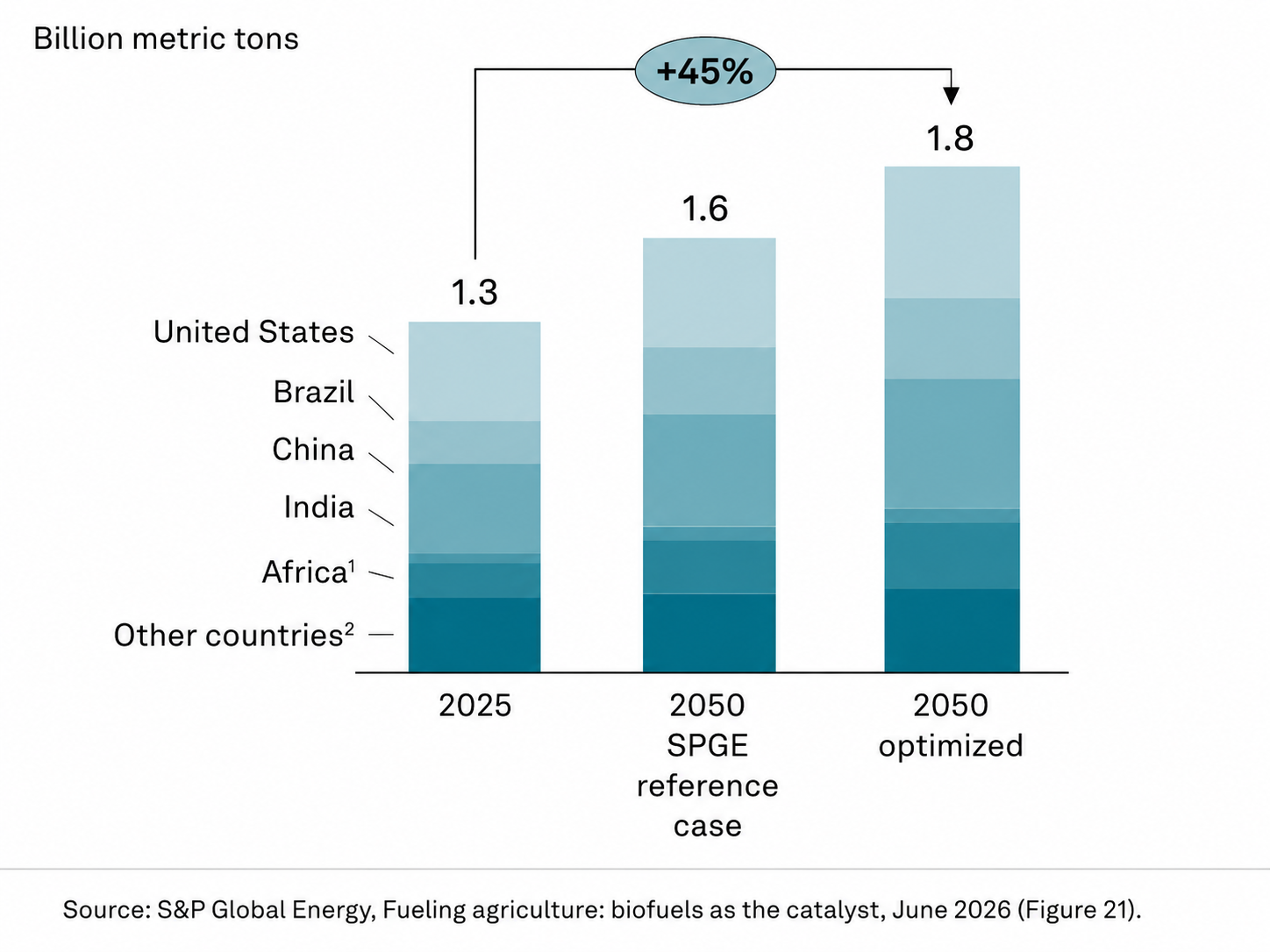
Figure 21 shows the report's optimized scenario for selected crops used in food and feed, including biofuel co-products like DDGS and oilseed meals.
Source: S&P Global Energy, Fueling agriculture: biofuels as the catalyst, June 2026, Figure 21.
The selected-country supply figure rises from about 1.3 billion metric tons in 2025 to 1.8 billion metric tons in the 2050 optimized case, which S&P describes as 45% higher food and feed supply relative to 2025. The report attributes that to a combination of technology, improved agronomic practices, yield optimization, and biofuel co-products returning to the feed system. It's still an optimized scenario, not a guaranteed future, but it's a real complication for a binary food-or-fuel framing: the system can potentially produce more feedstock, more co-products, and more food and feed supply at once, provided productivity actually rises that much.
Why this connects to low-CI agriculture
Productivity and carbon intensity can sound like separate conversations at first. One is about producing more; the other is about emitting less. For biofuel feedstocks, S&P links them directly, arguing that biofuel GHG performance can improve as agricultural productivity rises and sustainability practices spread across the value chain. That points toward a more specific goal than maximizing yield or minimizing emissions in isolation: improving emissions intensity while keeping the agricultural system productive and economically viable. A practice that cuts total emissions but sharply reduces output doesn't produce the same lifecycle result as one that improves input efficiency while holding or raising yield, and increasing yield at any environmental cost wouldn't satisfy the broader low-carbon goal either. Reduced-CI agriculture sits at that intersection.
Strong markets fund the next round of efficiency
S&P's argument depends on a historical pattern: agriculture invests in technology when demand gives it a reason to. That cycle matters for low-CI feedstocks because tools like precision nutrient systems, improved genetics, and better field-level data don't scale just because they exist. Growers need an economic reason to adopt them, and low-carbon fuel markets could supply one of those reasons if they create durable value for lower-emission, higher-efficiency feedstock.
A more useful set of questions
The old food-versus-fuel question was how much farmland biofuels would consume. S&P's report points toward a more useful set: how much additional production can come from higher yields, what market incentives are required to finance that productivity, how much food and feed supply remains after accounting for biofuel co-products, whether agricultural emissions intensity can improve at the same time, and what safeguards keep production growth from relying on environmentally damaging land expansion. Those questions are harder to answer than a slogan, but they track much more closely to how agriculture and biofuel supply chains actually operate.
None of this should be read as an argument for unlimited feedstock demand. S&P's optimized scenario is built around technology adoption, productivity, land constraints, and prioritizing food and feed needs, not growth without limits. The more interesting conclusion is that a larger biofuel industry and a more productive food system aren't necessarily in conflict: under the right conditions, biofuel demand can help create the signal that pushes farmers toward productivity investment, and a more productive system can supply additional feedstock without proportional land expansion. Low-CI agriculture adds one more dimension to that. If the market rewards lifecycle carbon performance alongside production volume, the incentive moves beyond yield alone, toward a system that produces more efficiently, with lower emissions intensity, on the land base it already has.
More in this series
- Part 1: Biofuels used to pay farmers for bushels. Low-CI markets could pay them for carbon intensity.
- Part 2: How much of ethanol's carbon intensity is actually on the farm?
- Part 3: From starch to oil to carbon intensity
- Part 4: Low-CI agriculture doesn't have a technology problem. It has an incentive problem.