Part 3 of a 5-part FDCIC series on S&P Global Energy's June 2026 report, Fueling agriculture: biofuels as the catalyst.
Agricultural commodities don't get their value only from what they are. They also get it from what downstream markets learn to do with them. Ethanol built a large market for the starch in corn. Biodiesel and renewable diesel built a much bigger one for soybean oil. S&P Global Energy's 2026 report, Fueling agriculture: biofuels as the catalyst, documents both shifts, and it raises a question worth sitting with: could carbon intensity become the next agricultural attribute a fuel market learns to pay for?
Ethanol changed the structure of corn demand, not just its volume
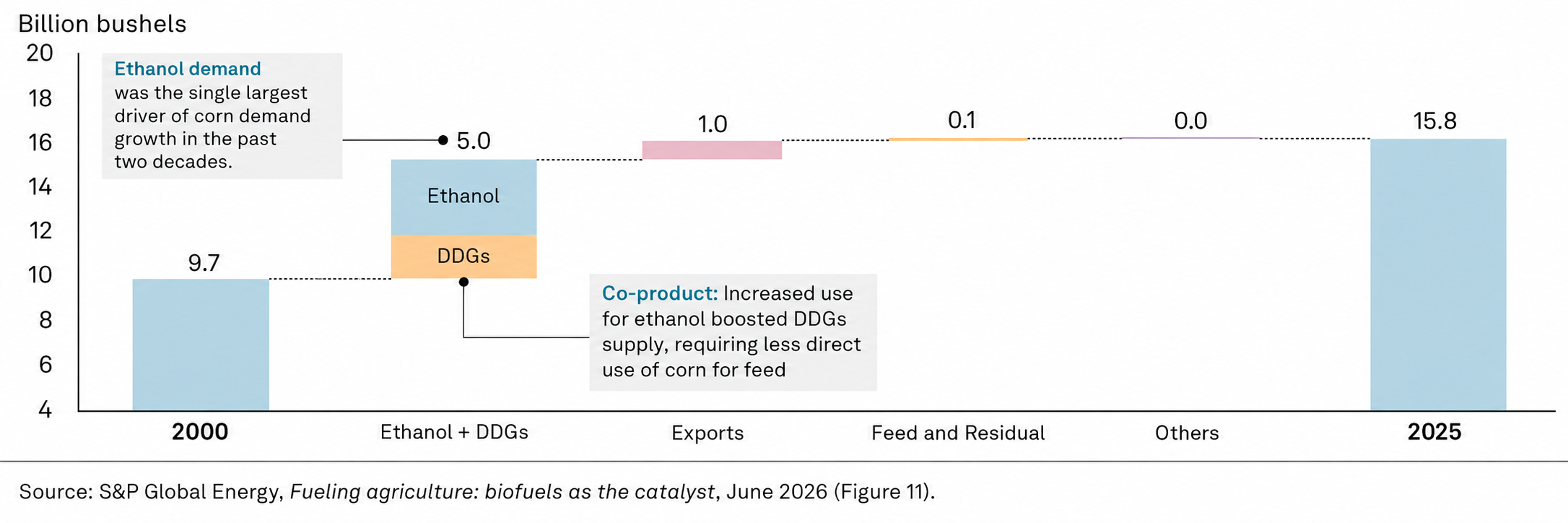
S&P estimates that roughly 83% of the net increase in U.S. corn demand since 2000 is attributable to ethanol expansion. The report shows U.S. corn use rising from about 9.7 billion bushels in 2000 to 15.8 billion bushels in 2025, with ethanol and its co-product dynamics accounting for most of that change.
Source: S&P Global Energy, Fueling agriculture: biofuels as the catalyst, June 2026, Figure 11.
That history matters for today's low-CI feedstock discussion. Corn starch existed long before the modern ethanol buildout. What changed was the scale and durability of the downstream market willing to turn that starch into fuel. The value wasn't created by inventing a new crop; it came from building a market for a characteristic the crop already had.
Renewable diesel changed what soybean oil is worth
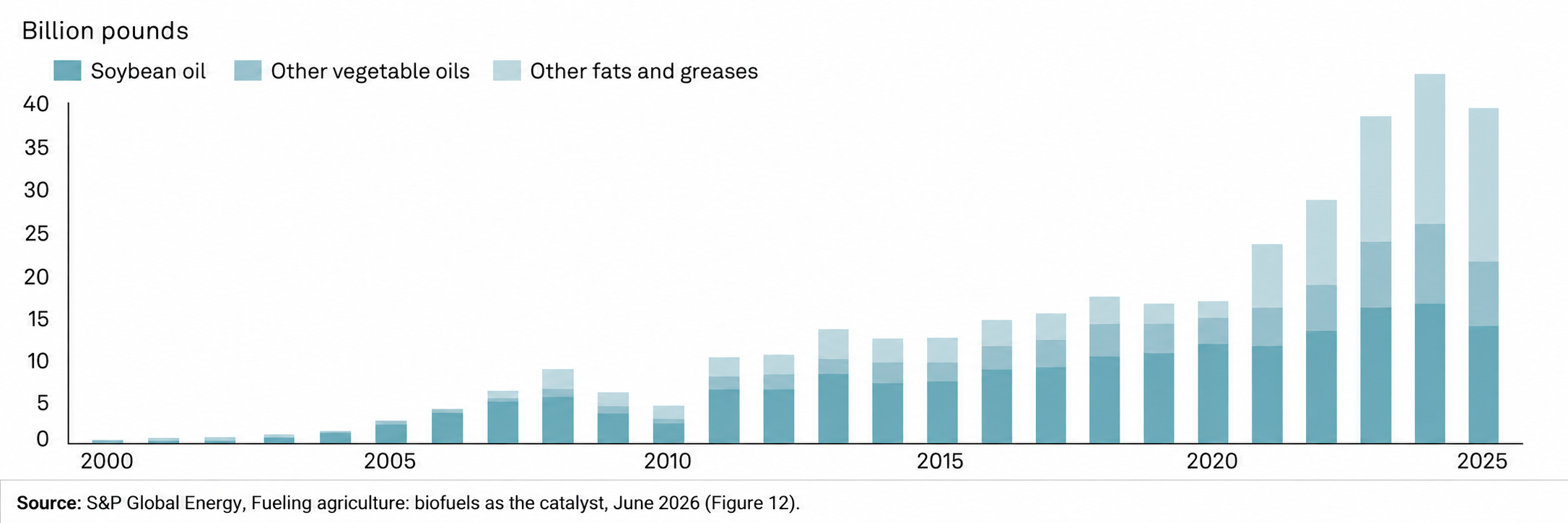
The soybean market tells a similar story. S&P documents rapid growth in biomass-based diesel feedstock use in the United States, including a large increase in soybean oil alongside other vegetable oils, fats, and greases.
Source: S&P Global Energy, Fueling agriculture: biofuels as the catalyst, June 2026, Figure 12.
Tim Ostrem, Director at the United Soybean Board, put the shift plainly in the report: "...about half of the value of soybeans comes from the oil—once something we barely paid attention to due to limited demand." The soybean didn't suddenly start containing oil. The market's willingness to pay for that oil changed, and S&P notes biofuel policy drove real investment in domestic soybean crush capacity as demand for the oil increased. The pattern in both crops is the same: a new downstream use repriced an attribute of a crop that was already there.
Carbon intensity could be the next attribute, with a catch
Starch and oil are physical characteristics you can measure at the elevator or the crush plant. Carbon intensity is an accounting outcome built from lifecycle emissions data, which makes it a different kind of attribute even though the underlying market logic is similar: if a downstream fuel policy pays more for lower lifecycle emissions, a feedstock that helps produce a lower-CI fuel becomes more useful to the buyer. That opens a new axis of agricultural differentiation on top of the traditional ones. A commodity buyer has long paid attention to moisture, protein, oil content, test weight, and grade. A low-CI fuel market adds a layer that traditional grading never touched: how the crop was produced, what emissions were associated with that production, what CI outcome a given methodology recognizes, and whether that outcome can be tied back to the specific feedstock a fuel producer used.
Carbon intensity isn't something you can test at the elevator
This is where reduced-CI grain gets operationally hard. A buyer can test moisture. A processor can measure oil content. Nobody can measure carbon intensity in the kernel, because it depends on production records and on the methodology used to translate those records into a lifecycle result. That means the commercial value of reduced-CI feedstock depends on data that has never traditionally traveled with the grain itself. A functioning market has to establish the link running from the farm to the production data to the CI outcome to the crop volume to the supply chain to the biofuel facility, and it has to keep that link intact through aggregation. S&P doesn't prescribe current accounting or chain-of-custody rules for farmer CI programs, but it repeatedly emphasizes market incentives, on-farm data, and measurable results as the ingredients that matter. Low-CI agriculture is as much a data and assurance problem as an agronomic one.
Co-products keep the crop in the food system too
S&P's historical analysis carries another lesson worth keeping: biofuel demand doesn't remove the whole feedstock from the food and feed system. In corn ethanol, starch converts to fuel while protein and fiber stay available through co-products like distillers grains. In oilseed processing, extracting oil for fuel also produces protein meal. The report frames crops as serving food, feed, and fuel at once, which matters for the carbon-intensity discussion because low-CI feedstock markets will sit inside these same interconnected value chains. A bushel of corn can still feed fuel and feed markets simultaneously. Carbon intensity would become another layer in that value stack, not a replacement for the others.
The market doesn't have to pay every farmer the same way
If a downstream buyer starts valuing CI, that doesn't dictate how the farmer gets paid. A program could offer a fixed participation incentive, a premium for qualifying feedstock, or compensation tied more directly to the CI outcome, and a buyer might only value reduced-CI feedstock in certain locations, seasons, or volumes depending on its own fuel pathway. Those are commercial design questions the S&P report doesn't answer. What the historical examples do show is that once a downstream market puts value on an attribute, supply chains reorganize around it: soybean crush capacity expanded with oil demand, and corn production grew alongside ethanol infrastructure. If carbon intensity becomes economically material to biofuel producers, agricultural procurement could shift the same way.
Low-CI feedstock as a commercial input, not just a sustainability story
This is the point that gets lost when reduced-CI agriculture gets treated purely as a climate initiative. If a CI outcome affects the value of the downstream fuel, low-CI feedstock becomes a commercial input, and the buyer may be purchasing a feedstock characteristic that changes fuel-production economics rather than a sustainability narrative. That changes what a farmer program has to be designed around: it has to work for growers, aggregators, and processors while producing information the downstream fuel producer can actually use.
Energy markets have already changed the value structure of two major crops. Ethanol repriced corn starch. Biodiesel and renewable diesel repriced soybean oil. Carbon-intensity policy may now create a market for another agricultural characteristic, one based not on what the crop contains but on how it was produced. If that happens, the next transformation in biofuel feedstocks may show up less in a new processing plant and more in the information attached to the bushel.
More in this series
- Part 1: Biofuels used to pay farmers for bushels. Low-CI markets could pay them for carbon intensity.
- Part 2: How much of ethanol's carbon intensity is actually on the farm?
- Part 4: Low-CI agriculture doesn't have a technology problem. It has an incentive problem.
- Part 5: More biofuels without more farmland?